
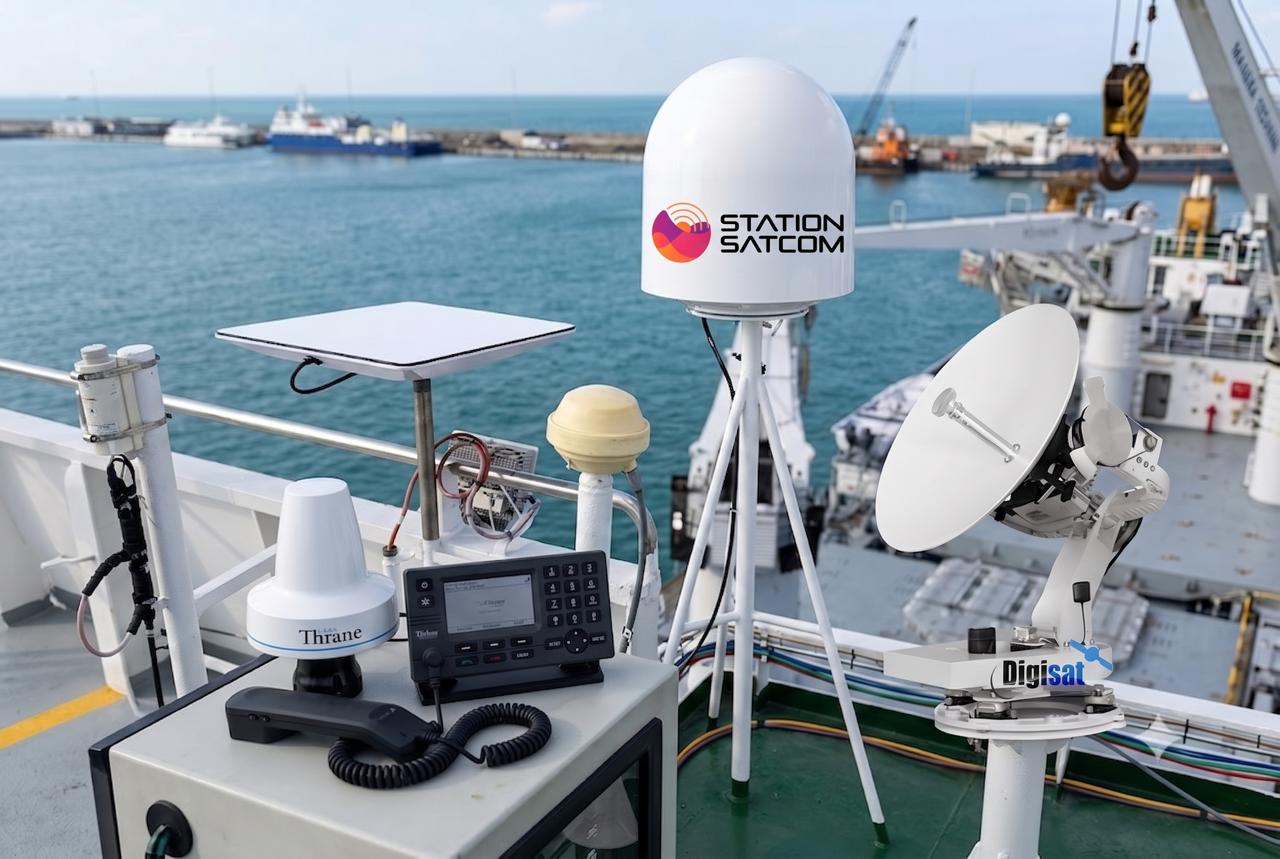






















In today’s hyper-connected world, uninterrupted communication at sea is no longer a luxury—it’s mission-critical. Whether it’s a cargo ship crossing the Indian Ocean, a patrol vessel conducting defense surveillance, or an offshore platform managing oil extraction, connectivity powers it all. At the heart of this maritime digital infrastructure lies VSAT— Very Small Aperture Terminal — a satellite communication system that has become indispensable for vessels operating beyond coastal coverage.
As maritime industries digitize operations and demand higher levels of safety, compliance, and efficiency, VSAT internet for ships has emerged as the backbone of offshore communication. This guide offers a comprehensive look at how VSAT works, why it remains relevant in the age of Low Earth Orbit (LEO) satellites, and what the future of marine connectivity looks like.
Understanding VSAT: How It Works
VSAT is a two-way satellite ground station that includes a compact dish antenna, typically 0.75 to 2.4 meters in diameter. Mounted on vessels, these antennas establish a continuous link with Geostationary Earth Orbit (GEO) satellites that hover at approximately 35,786 km above Earth. GEO satellites maintain a fixed position relative to the planet, allowing stable, long-duration communication links with mobile terminals on the ocean.
The key components of a maritime VSAT system include:
- Stabilized antenna system for automatic satellite tracking
- Below-deck equipment such as modems, routers, and control units
- Satellite bandwidth from providers like Intelsat, SES, or Viasat
- Network Management System (NMS) for monitoring usage and quality
With Ku-band and Ka-band frequencies being widely adopted, VSAT offers scalable bandwidth options, robust uptime, and wide geographic coverage — from the Equator to high-latitude seas.
Why VSAT Still Matters in Maritime Operations
Despite technological advancements, VSAT remains vital for several mission-critical use cases:
1. Crew Welfare and Retention
Internet access is a key component of modern crew welfare. Seafarers expect the ability to connect with family via WhatsApp, video calls, or social media. VSAT ensures reliable access to these services, even in mid-ocean.
2. Operational Intelligence and Efficiency
Real-time monitoring of vessel performance, predictive maintenance, remote IT support, and ECDIS updates are all enabled by satellite connectivity. VSAT forms the communication backbone for these data-heavy tasks.
3. Compliance with Maritime Regulations
IMO guidelines, cyber risk protocols, and environmental reporting mandates all require secure, traceable, real-time communication. VSAT supports encrypted channels and automated compliance reporting.
4. Safety and Surveillance
From CCTV offloads and incident alerts to encrypted communications with coastal authorities, VSAT empowers safety operations across the vessel.
GEO vs. LEO: Complementary, Not Competitive
With the rapid growth of LEO satellite constellations like Starlink and OneWeb, many have questioned whether VSAT’s GEO-based architecture will soon become obsolete. The reality is that GEO and LEO are not adversaries — they’re allies in delivering truly reliable, high-performance maritime internet.
Strengths of GEO (VSAT-based Systems)
- Wide coverage with minimal infrastructure: Just three GEO satellites can cover most of the globe, including deep-sea lanes.
- Cost-efficient for bulk data and non-real-time services: GEO is ideal for tasks like firmware updates, media downloads, or IoT offloads.
- Proven reliability and regulatory acceptance: GEO systems have decades of uptime history and are already compliant with global maritime rules.
Strengths of LEO (Low Earth Orbit)
- Low latency (<50 ms): Ideal for real-time applications like telemedicine, video conferencing, and remote control systems.
- High throughput bandwidth: LEO offers speeds exceeding 200 Mbps in some implementations.
- Cloud-native infrastructure: Better suited for dynamic, intelligent traffic routing and software-defined networking.
The Rise of Hybrid Maritime Networks
Modern vessels are no longer relying on a single type of satellite link. Instead, they’re adopting hybrid, multi-orbit networks that intelligently blend VSAT with LEO connectivity.
These setups are designed to route data based on:
- Latency requirements (e.g., route real-time data via LEO, bulk uploads via GEO) • Weather or signal quality
- Application priority
- Geographic location and regulatory considerations For example:
- Primary use: LEO link for interactive tasks and crew welfare
2. Secondary/fallback: GEO-based VSAT for resilience and backup
3. Traffic shaping: Dynamic bandwidth allocation to balance costs and performance
This orchestration is powered by multi-WAN routers, SD-WAN overlays, and increasingly, AI-driven orchestration tools.
Future of VSAT: Smarter, Stronger, More Integrated
VSAT is not being phased out—it is being future-proofed. As vessels demand more intelligent networking, VSAT systems are evolving in several critical ways:
1. AI-Enhanced Traffic Management
Systems can now auto-detect bandwidth spikes, re-route traffic across LEO and GEO, and prioritize mission-critical applications in real time.
2. Real-Time Monitoring and Predictive Maintenance
Integrated sensors and analytics platforms allow ship operators to monitor signal quality, forecast disruptions, and reduce downtime.
3. Cloud-Native Compatibility
New VSAT platforms integrate seamlessly with cloud-based applications like Azure, AWS, and Office 365, enabling more robust IT environments at sea.
4. On-Demand Bandwidth and Elastic SLAs
Rather than fixed contracts, operators are moving toward pay-as-you-use pricing, scaling bandwidth up or down based on voyage duration or zone of operation.
VSAT’s Role in the Next Era of Maritime Connectivity
In the world of maritime connectivity, reliability is everything. While LEO satellites bring speed and responsiveness, GEO-powered VSAT offers coverage, cost efficiency, and maturity. Together, they create the most resilient network possible — one that adapts to mission requirements, ensures 24/7 uptime, and empowers smarter shipping operations.
As connectivity joins fuel, food, and safety as a critical utility onboard, VSAT remains not just relevant but central to the future of maritime communications. It is no longer just a “dish on a mast” — it is a smart, secure, and scalable gateway to the digital ocean.