


When a crew member says, “The internet is down again,” it rarely stays a small complaint. It affects mood, recovery, and focus. Over time, it shows up in retention, teamwork, and the quality of day-to-day execution.
That is why maritime satellite connectivity is not just a technology choice. It shapes crew connectivity at sea, which directly influences welfare and performance onboard.
Connectivity has become a welfare baseline
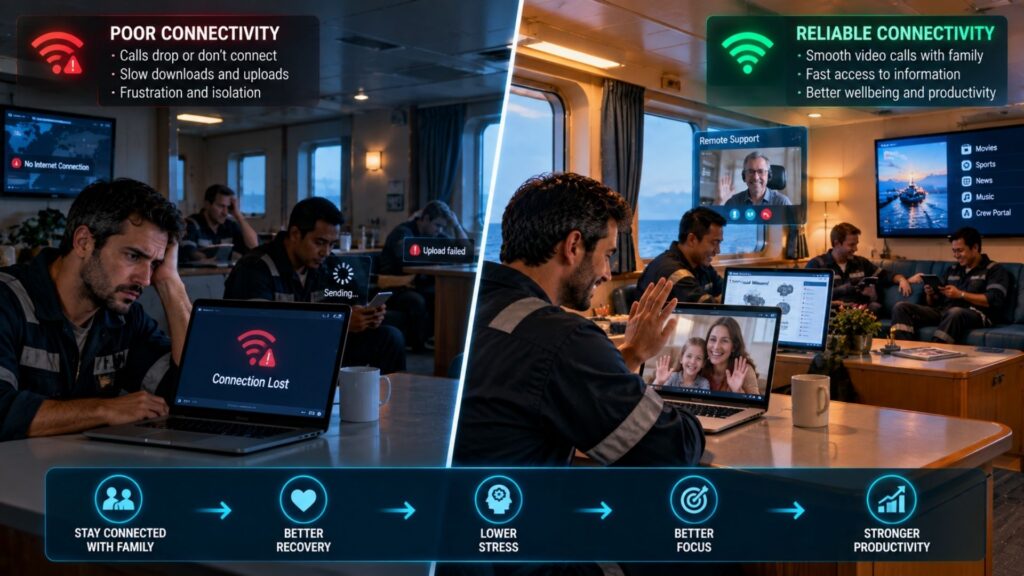
For many crews, staying connected to family is part of staying steady at sea. When satellite connectivity crew access is reliable, off watch time actually feels like recovery. When it is unreliable, isolation rises and fatigue feels heavier.
This is one of the most practical ways to improve crew welfare with connectivity. Not by adding more apps, but by making access predictable, fair, and consistent.
How reliable connectivity improves onboard productivity
Reliable internet at sea supports productivity in ways that are easy to measure:
- Fewer delays in ship shore coordination
- Faster access to manuals, updates, and documentation
- Smoother remote support and troubleshooting
- Less time wasted retrying uploads, calls, and sessions
- Better focus during work hours because off watch recovery improves
That is the importance of reliable ship internet. It reduces friction across both people and processes.
The hidden link between morale and performance
Crew welfare and productivity are not separate topics onboard. They reinforce each other.
The benefits of reliable satellite internet for crews include more than entertainment. Reliable connectivity supports:
- Lower stress and better mental wellbeing
- Stronger morale and fewer onboard conflicts
- Better communication habits
- Higher retention and continuity across tours
When crews feel connected, they tend to operate with more calm, clarity, and consistency.
What “reliable” looks like in the real world
Reliability is not only speed. It is continuity.
Strong maritime satellite connectivity usually depends on resilient design, not a single link. Multi orbit options, managed routing, and clear traffic separation help ensure that crew usage does not interfere with operational needs.
The outcome should feel simple onboard:
- Crew internet stays usable during peak hours
- Critical ship systems stay protected and prioritized
- The experience remains consistent across routes and conditions
Where Station Satcom solutions fit
Station Satcom supports fleets that want connectivity to improve both operational outcomes and crew welfare.
For crew welfare and engagement, solutions like Station Multiplex, Station Kiosk, and Crew Kiosk help create a better onboard experience. For wellbeing support, Station Care adds a structured layer that supports healthier, more resilient crews. Combined with fleet connectivity options designed for global routes, these solutions help crews stay connected while operations stay steady.
The bottom line
Reliable internet at sea has moved from nice to have to operationally relevant. It improves crew welfare, which improves stability, which improves productivity. If you want better performance onboard, start with crew connectivity at sea that crews can trust.
If you want to strengthen crew welfare and onboard productivity with reliable maritime connectivity, write to sales@stationsatcom.com. Share your vessel type, current setup, and crew usage needs, and we will suggest a practical approach using Station Satcom connectivity plus Station Multiplex, Station Kiosk, Crew Kiosk, and Station Care.
FAQs
1. What does reliable crew connectivity at sea actually mean?
Consistent access during off watch hours with predictable performance, not just peak speed numbers.
2. Will improving crew internet affect operational traffic?
Not if the network is designed with clear separation and prioritization for critical systems.
3. How can connectivity improve crew welfare?
By reducing isolation and stress, supporting communication with home, and improving off watch recovery.
4. What is the biggest productivity gain from reliable ship internet?
Faster ship shore coordination and fewer delays in remote support, updates, and documentation.
5. What should fleets evaluate when upgrading maritime satellite connectivity?
Route coverage, continuity across conditions, managed monitoring, and the ability to support both operations and crew needs consistently.