




















A Quiet Shift on the High Seas
Twenty years ago, a vessel’s environmental footprint was largely invisible to the crew. Fuel burned, bilge discharged, emissions vented—monitored in logbooks, not in real time. Today, sensors on a ship’s hull can tell us exactly how much CO₂ it’s producing per nautical mile, where ballast water is being released, and whether route deviations are increasing fuel burn.
This isn’t just because shipbuilders got greener. It’s because connectivity got smarter. The same satellite technologies we once deployed purely to keep a captain in touch with shore are now central to cleaning up our oceans. And as we enter what I call the Green Satcom Revolution, the future of maritime sustainability will be shaped not just by better ships—but by better signals.
Why This Matters
The maritime sector accounts for nearly 3% of global greenhouse gas emissions, a number projected to rise if shipping volumes keep climbing. Regulatory bodies like the IMO have set ambitious decarbonisation targets, pushing operators toward low carbon fuels, route optimisation, and digitalisation of environmental reporting.
But these green shifts rely on one thing: continuous, reliable, and intelligent data flow from vessel to shore. That’s where satellite communications—especially multi orbit, application first designs—come in.
From Deck to Data Centre: The Sustainability Link
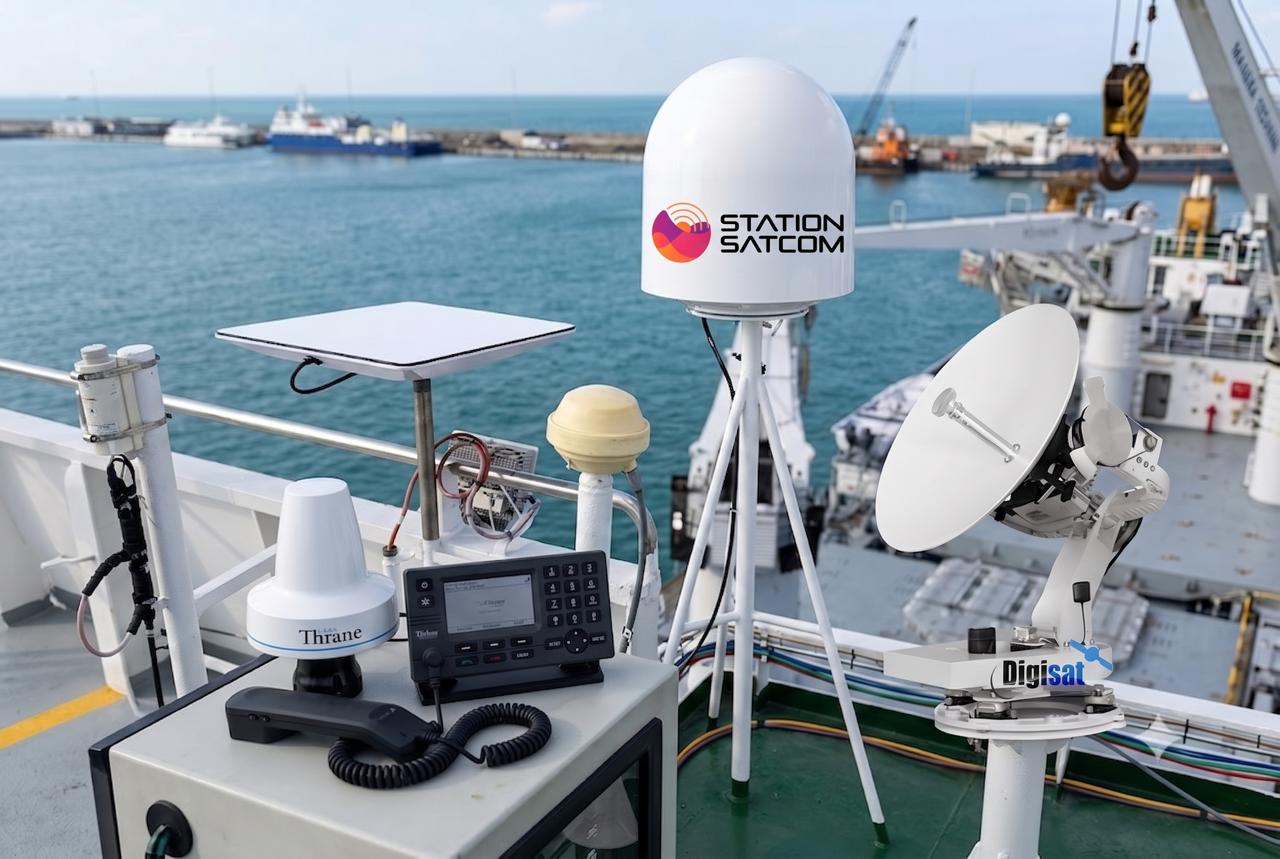
When Station Satcom first began deploying hybrid LEO–GEO networks at sea, our aim was operational uptime. Today, those same architectures are enabling:
Fuel Optimisation: Real time engine performance and weather data let captains adjust routes for maximum fuel efficiency, cutting CO₂ emissions by up to 10% per voyage.
Emission Monitoring: Continuous feeds from stack sensors are transmitted to compliance platforms, ensuring MARPOL Annex VI limits are never breached.
Wastewater Tracking: IoT enabled bilge and ballast sensors send instant alerts if discharge parameters exceed legal thresholds.
AI Powered Routing: Low latency LEO links allow machine learning algorithms ashore to recalculate courses mid voyage, avoiding heavy seas and reducing unnecessary fuel burn.
Each of these capabilities is connectivity dependent. Without a robust satcom backbone—resilient in storms, compliant in restricted waters, and elastic in bandwidth—green intentions remain just that: intentions.
Technology Deep Dive: Making Satcom Itself Green
It’s not enough for satellites to enable greener operations—they themselves must be part of the sustainability equation. The industry has made notable advances:
Electric Propulsion Satellites: Many new crafts use electric ion thrusters, drastically reducing launch mass and fuel requirements.
Reusable Launch Systems: SpaceX and other launch providers are cutting the carbon cost per satellite by reusing boosters.
End of Life Deorbit Plans: Operators now commit to moving defunct satellites into graveyard orbits or controlled re entry, reducing space debris.
Ground Station Efficiency: Renewable powered teleports and intelligent cooling systems are lowering the terrestrial footprint of satellite networks.
At Station Satcom, we’ve extended this thinking to our own deployments: consolidating shipboard hardware into multi WAN, multi orbit controllers, reducing antenna swaps and the materials footprint over a vessel’s lifecycle.
Lessons from the Field
One of our most impactful deployments was on a fleet of offshore support vessels operating in the North Sea—an area with strict environmental compliance. The operator’s challenge was two fold: monitor fuel burn and emissions in real time, and send that data to shore for instant analysis.
We implemented a hybrid LEO–GEO network: LEO for the continuous, low latency sensor streams, and GEO for high volume batch transfers of historical voyage data. Using AI driven analytics ashore, the operator cut average fuel consumption by 8% in six months, while also proving compliance during random inspections without a single data gap.
It’s a textbook case of how sustainability gains often start as connectivity gains.
The Regulatory Tide Is Rising
Environmental compliance isn’t optional anymore. The IMO’s Carbon Intensity Indicator (CII) ratings and EU’s Emissions Trading System now carry financial penalties for poor performance. That means vessels without continuous monitoring risk not just reputational damage, but tangible costs.
Multi orbit satcom is uniquely positioned to support compliance:
Redundancy: If a LEO link drops mid storm, GEO or L Band takes over, ensuring no reporting gaps.
Regional Flexibility: Some LEO services face regulatory restrictions in certain EEZs. Our Unified Control Layer automatically switches to permitted links to maintain legal operation
Security: Environmental data is sensitive. We embed role based access control and encrypted transmission to prevent tampering
Beyond Compliance: Toward Regenerative Oceans
The next wave of green satcom is about more than reducing harm—it’s about actively restoring marine ecosystems. Here’s where I see opportunity:
Remote Marine Protected Area (MPA) Monitoring: Satellites enable AI powered vessel detection to spot illegal fishing in real time.
Plastic Pollution Tracking: Sensor equipped buoys can relay debris drift patterns for targeted clean up missions.
Coral Reef Health Mapping: LEO imagery satellites combined with on site sensor networks give marine biologists unprecedented visibility.
These applications extend satcom’s role from an enabler of cleaner operations to an active participant in ocean health.
Our Approach: Sustainable by Design
At Station Satcom, sustainability is not an afterthought—it’s embedded in our architecture decisions. Every deployment we design for maritime clients now considers:
Lifecycle Impact: Fewer, smarter devices with remote upgrade capabilities to reduce physical replacements.
Energy Efficiency: Low draw shipboard hardware and adaptive power modes during low traffic periods.
Vendor Selection: Partnering with satellite operators who publish environmental impact reports and adopt green manufacturing practices.
Hybrid Redundancy: Designing networks that prevent costly, fuel intensive detours caused by comms outages.
The result is a connectivity layer that aligns with the client’s ESG goals as closely as it does with their operational KPIs.
The Horizon Is Open
The Green Satcom Revolution is not a distant vision—it’s happening right now, in fleets we serve from the Andaman Sea to the Gulf of Mexico. Every optimized route, every kilobyte of emissions data, every gram of CO₂ saved is a reminder that technology and sustainability are not parallel tracks—they’re converging.
Our legacy at Station Satcom is maritime first. But as we expand into hybrid and terrestrial networks, our responsibility scales too. Cleaner oceans demand cleaner signals. And in this revolution, every orbit matters—LEO for the agility, MEO for the balance, GEO for the reach.
From deck to data centre, our mission remains clear: keep vessels connected, compliant, and committed to the oceans they sail.
Because when the sea thrives, so do we all.