


Poor internet at sea rarely fails in a dramatic way. It fails quietly.
A call that drops just as remote support starts. A file upload that keeps retrying. A patch that cannot complete. A crew connection that works one minute and collapses the next. These moments feel small, but across a fleet they add up to real cost.
This is the part many operators miss. The true price of ship internet problems is not only the monthly bill. It is the time lost, the risk added, and the productivity that never shows up on a report.
The hidden costs of poor internet at sea
1. Slower ship shore decisions
When maritime internet connectivity is inconsistent, ship shore coordination becomes slower and more manual. Teams fall back to shorter updates, incomplete reporting, and delayed approvals.
2. Remote support turns into downtime
Satellite internet for ships is a lifeline for troubleshooting. But poor links stretch a simple support session into hours. In some cases, you end up waiting for the next port instead of fixing issues while underway.
3. Security exposure grows
Unstable connectivity often leads to workarounds. Shared credentials, delayed updates, skipped monitoring. Over time, this expands the attack surface and increases the impact of poor internet on ship operations.
4. Crew welfare takes a hit
Crew connectivity at sea is no longer a perk. When crews cannot reliably connect with home, fatigue and frustration rise. That impacts morale, retention, and day to day performance onboard.
5. Bandwidth waste and unpredictable costs
When systems keep retrying downloads, uploads, and video sessions, you burn bandwidth without progress. The result is more spend, more complaints, and no measurable improvement.
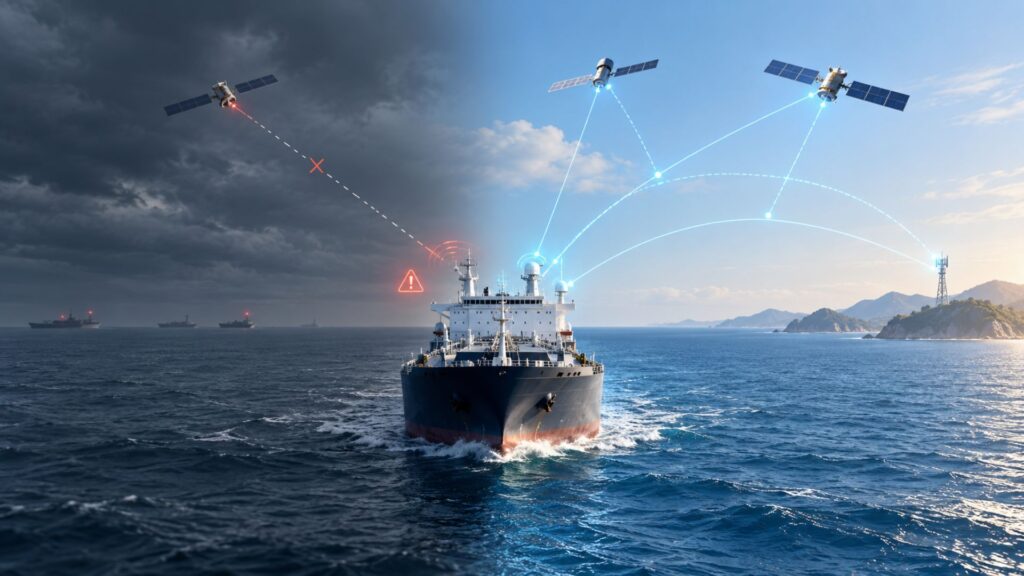
Why ship internet problems persist
Most vessels are not struggling because they picked the wrong antenna. They struggle because the link is treated as one pipe for everything.
Operational traffic, crew usage, remote support, software updates, and security tools all compete for the same connection. Without routing intelligence, traffic management, and resilience across routes, poor internet at sea becomes the default experience.
How to improve internet connectivity on ships
A practical fix usually involves three moves.
1. Build resilience with multi orbit options
Coverage and performance change by route, weather, congestion, and satellite geometry. A resilient design combines options like LEO for low latency and real time applications, GEO for steady wide coverage, and L band for critical backup where needed. The goal is continuity, not just speed.
2. Add network control, not just bandwidth
The real improvement comes when your network can decide what matters most. Policy based routing prioritizes critical vessel traffic, stabilizes VoIP and video, and keeps essential workflows running even when a link degrades.
This is where a fleet networking layer like FutureKonnect helps, giving ship and shore teams clearer control over routing, segmentation, and performance.
3. Separate crew welfare from operations
Crew welfare improves when crew traffic is managed properly, not when it is restricted. With dedicated crew welfare solutions, you can deliver a better experience without disrupting operational systems.
Station Multiplex supports licensed shared entertainment, while Station Kiosk and Crew Kiosk help deliver onboard updates and engagement content more consistently. This reduces friction onboard and supports better retention.
Where Station Satcom offerings fit, briefly
If you are addressing maritime internet connectivity at a fleet level, Station Satcom typically supports four layers:
- Connectivity options for global routes across Starlink, OneWeb, Iridium Certus, VSAT, LTE, and more
- Fleet networking and traffic control with FutureKonnect to improve performance consistency
- Managed IT and monitoring through Station 365 to reduce recurring ship internet problems
- Cybersecurity controls with Station Guard and SecureX aligned capabilities to strengthen readiness
- Crew welfare and engagement through Multiplex, Kiosk, Crew Kiosk, and Care
- Operational visibility through solutions like WatchX and Watch for surveillance and incident readiness
The outcome is simpler: fewer vendors, clearer accountability, and a more stable experience ship wide.
The bottom line
Poor internet at sea creates hidden cost because it interrupts everything that depends on continuity: operations, security, support, and people. Fixing it is not about chasing a bigger plan. It is about building resilience, controlling traffic, and designing for both operations and crew welfare.
If you want a practical plan to improve internet connectivity on ships, write to sales@stationsatcom.com. Share your vessel type, routes, current setup, and top pain points, and we will recommend a phased approach using the right connectivity mix plus FutureKonnect, Station 365, Station Guard, and crew welfare options like Multiplex and Kiosk.
FAQs
1. What is the biggest cause of poor internet at sea?
A single link carrying every type of traffic without routing control, prioritization, or separation.
2. Does adding more bandwidth solve ship internet problems?
It helps, but stability usually improves most when routing and traffic policies are added.
3. How can fleets improve crew connectivity at sea without impacting operations?
By separating crew usage from operational traffic and managing priorities with clear policies.
4. What should operators look for in satellite internet for ships?
Route fit, continuity under load, link diversity, and the ability to manage traffic intelligently.
5. How quickly can fleets see improvement?
Often within the first rollout phase once traffic control, monitoring, and segmentation are implemented.