


In 2026, maritime cyber threats are no longer IT issues. They are operational risks. When systems slow down, remote support fails, or visibility drops mid voyage, the impact is felt on schedules, safety, and business continuity.
The maritime reality makes this harder than most industries. Connectivity varies by route. Crews rotate. Ship and shore workflows are intertwined. And attackers know that disruption at sea costs more. That is why vessel cyber security needs to focus on prevention, early detection, and faster recovery, not just compliance paperwork.
Below are the most likely patterns behind shipping cyber-attacks in 2026 and what they typically look like in real operations.
1. Ransomware and extortion that targets uptime
Ransomware remains one of the most damaging shipping cyber-attacks because it is designed to interrupt operations, not just steal data. Modern campaigns often include extortion and data leakage to increase pressure.
If you want maritime ransomware attacks explained in one line: it is a business disruption play that exploits weak access controls, delayed patching, and untested recovery.
What it can look like
- Sudden lockouts from critical systems
- Access failures across shared applications
- Unusual account activity before the outage
- Backups that do not restore cleanly when needed
How Station Satcom helps
A managed IT baseline like Station 365 supports secure, fully managed vessel IT with centralized control and operational continuity in mind, reducing the gaps that ransomware exploits.
2. Remote access compromise and edge device attacks
The most common doorway is still remote access. VPNs, firewalls, routers, and onboard gateways are attractive because they sit between ship and shore.
What it can look like
- Unknown sessions or logins at odd hours
- Configuration changes that degrade performance
- New devices appearing on the network
- Lateral movement across systems that should be isolated
How Station Satcom helps
Station SecureX is positioned as a cybersecurity and network management layer for fleets, built to keep vessel to shore communication secure while simplifying complex network configurations and applying policies consistently.
3. Phishing and credential theft that triggers bigger incidents
The most frequent starting point for common cyber-attacks on ships is still human. Phishing, impersonation, and credential harvesting work because crews rotate, time is tight, and access is sometimes shared.
What it can look like
- Unusual mailbox rules or forwarded messages
- Sudden login failures or account lockouts
- Surprise payment requests or changed bank details
- Credentials used from unexpected locations
How Station Satcom helps
With managed IT under Station 365 plus cybersecurity services, fleets can improve identity controls, harden access, and reduce the workarounds that attackers rely on.
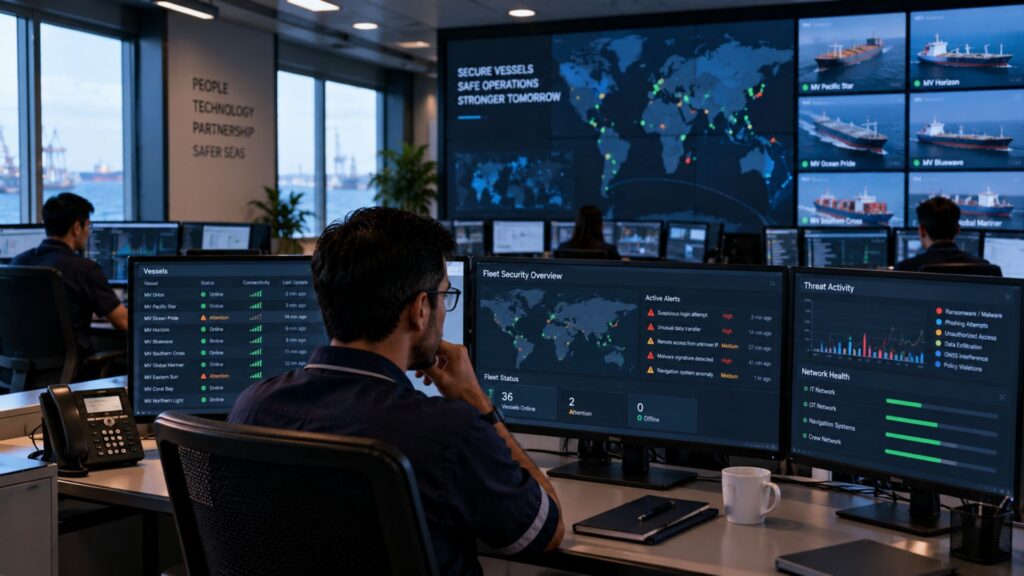
4. OT adjacent disruption and misconfiguration risk
Even when attackers start in IT, the consequences can spill into operational systems through poor separation, misconfigured networks, or uncontrolled access.
What it can look like
- Unexpected system behavior or repeated alarms
- Unplanned reboots or configuration drift
- Performance degradation that gets blamed on “normal issues”
- Slow escalation because nobody is sure what is happening
How Station Satcom helps
Station SecureX supports fleet scale control and visibility, while managed IT under Station 365 helps standardize and manage vessel networks so segmentation and access policies remain consistent across the fleet.
5. GNSS interference and navigation related attacks
Not all maritime cyber threats target servers. Signal based disruption is rising. Jamming and spoofing incidents can degrade trust in positioning and timing, especially in high-risk regions.
What it can look like
- Position drift that does not match radar or visual bearings
- Frequent loss of GNSS lock
- Timing anomalies across systems
How Station Satcom helps
Station Satcom supports NAVCOM and operational solutions, including navigation resilience deployments like SafeCaptain with SafePilot P1 and P1 Plus for GPS spoofing and jamming mitigation.
6. Surveillance – blind spots and weak incident evidence
Cyber risk also shows up in physical security and incident handling. When visibility is limited, investigations take longer and response becomes slower.
What it can look like
- Delayed detection of restricted area activity
- Difficult or slow evidence retrieval
- Inconsistent incident logs across vessels
How Station Satcom helps
Station Watch and Station WatchX are positioned around real time monitoring, bandwidth efficiency, and incident readiness, helping ships improve visibility and evidence trails across the fleet.
How Station Satcom can help mitigate these threats
Station Satcom supports an end-to-end approach that matches how fleets actually operate.
- Managed vessel IT through Station 365 to standardize, secure, and monitor onboard IT
- Cybersecurity and network management through Station SecureX to strengthen control, routing, and fleetwide security posture
- Cybersecurity services to improve protection, monitoring, and readiness across ship and shore environments
- Operational visibility and surveillance through Station Watch and Station WatchX
- Navigation resilience through solutions like SafeCaptain with SafePilot P1 and P1 Plus for GNSS spoofing and jamming risk
The goal is simple: fewer weak links, faster detection, clearer control, and steadier operations at sea.
If you want to map these threats to your fleet and prioritize actions, write to sales@stationsatcom.com. Share your vessel count, routes, and current setup and we will recommend a practical roadmap using Station 365, Station SecureX, and relevant operational solutions.
FAQs
1. What are the most common cyber-attacks on ships today?
Phishing and credential theft, ransomware, and remote access compromise remain the most frequent starting points.
2. Why do shipping cyber-attacks cause so much disruption?
Because ship systems are remote, interdependent, and time sensitive. Small failures spread quickly when access and segmentation are weak.
3. Does improving connectivity increase cyber risk?
Connectivity increases the attack surface if unmanaged. With the right controls and monitoring, it improves operational continuity and response.
4. What is the fastest way to reduce risk in 2026?
Tighten remote access, standardize vessel IT, apply consistent security policies fleetwide, and improve detection and incident readiness.
5. How do I know where my biggest exposure is?
Start with visibility: what is onboard, who has access, how networks are segmented, and what monitoring and response exists today.